
 Knife Design as Craft, Engineering and Functional Art

Before discussing knife design, it is worth making an important distinction.
This page is not about designing weapons for use against people. It does not cover fighting, self-defence techniques or the use of blades to cause harm.
The subject here is the design of edged tools, handmade knives, historical forms and collectible blades.
Knives are among humanity’s oldest tools, and the craft surrounding them has developed into something far broader than their historical use in warfare. Modern knife makers produce working knives for trades, outdoor use, food preparation and specialist tasks, alongside high-end collectors’ knives, display pieces, historical reproductions, daggers, swords and other forms of edged craftsmanship.
Many of these objects are collected in much the same way as fine watches, sculpture, mechanical instruments or antique tools. Their value can lie in the design, workmanship, materials, history and individuality of the maker.
Calling everything with a blade simply a “weapon” misses much of what modern knife making actually is.
At its best, knife design sits somewhere between engineering and sculpture.
Form Must Follow Purpose
A successful knife begins with understanding what it is intended to do.
A kitchen knife, bushcraft knife, carving knife, hunting knife, workshop knife and collector’s dagger may all contain the same basic elements, but their proportions and geometry can be completely different.

The intended role influences almost everything that follows: blade length, width, thickness, handle shape, balance, edge geometry and material choice.
Design therefore begins with purpose rather than decoration.
A beautiful knife that performs badly is an ornament. A highly functional knife with poor proportions may work perfectly but have little character.
Good knife design attempts to achieve both.
Proportion
Proportion is one of the most important elements of blade design.
The blade, handle, guard, ricasso, choil and other features need to feel as though they belong to the same object.

Small changes can dramatically alter the character of a design.
A slightly longer handle can make a blade appear shorter. Increasing blade depth can make the entire knife appear heavier. Moving the widest point of the blade by only a small amount can change the visual flow of the whole design.
Experienced designers often recognise good proportion almost instinctively.
The knife should look balanced before it is ever manufactured.
The Flow of the Design
One of the easiest ways to distinguish a well-designed knife from an awkward one is to follow its lines.
The spine, cutting edge, handle and major transitions should normally appear to belong to a continuous visual language.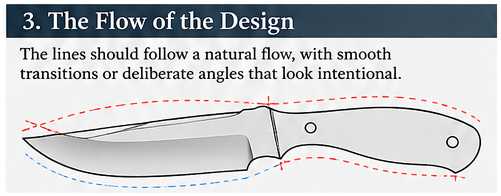
This does not mean every line must be smooth or curved. Angular and geometric designs can work extremely well.
What matters is intentionality.
A sudden change in direction should look deliberate rather than accidental. Curves should meet other elements cleanly, and the handle should visually support the form of the blade.
A good design often has a natural sense of movement even while sitting perfectly still.
Ergonomics
A knife is also a hand-held object.
However attractive the drawing may be, the handle must ultimately accommodate a human hand.

Handle length, thickness, curvature and contour all influence comfort and control. Finger positions, palm support and transitions between different surfaces should be considered from the beginning rather than added afterwards.
One of the advantages of designing digitally is that handle geometry can be revised repeatedly without wasting material.
Dimensions can be checked, curves adjusted and different versions compared before steel or handle material ever reaches the workshop.
Blade Geometry
Blade geometry determines much of how a knife behaves as a tool.
Thickness, taper, edge geometry and blade profile affect cutting characteristics, weight and durability.
There is rarely a single “correct” geometry.

A heavy outdoor knife has different requirements from a fine kitchen blade. A carving knife requires something different again.
This is why knife design should not simply be about drawing an attractive silhouette. The designer needs to consider the three-dimensional object that will eventually emerge from that outline.
Balance
Physical balance and visual balance are related, but they are not identical.
A knife can appear perfectly balanced on paper while feeling completely different once manufactured.
Blade mass, tang construction, handle materials, fittings and hardware all influence the finished centre of gravity.
For working knives, this can affect comfort and fatigue.
For collector pieces, balance also contributes to the impression of quality. A well-made object tends to feel deliberate when it is picked up.
Materials Are Part of the Design
Steel and handle material should not be treated as an afterthought.
Different steels offer different combinations of hardness, toughness, corrosion resistance and ease of finishing.
Handle materials introduce another set of considerations including strength, moisture resistance, texture, weight and appearance.

Wood, composites, horn, bone, metals and modern engineered materials can produce completely different personalities from the same underlying knife design.
The designer is therefore working not only with shape, but with mass, texture, colour and material behaviour.
Construction
A design must also be manufacturable.
Tang shape, pin positions, fasteners, guards, bolsters and handle scales all need sufficient material around them to remain practical.
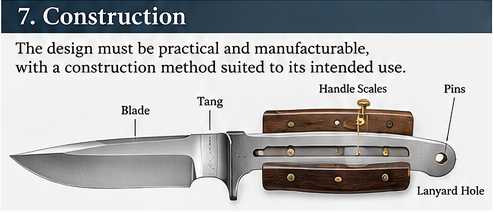
Beautiful drawings sometimes become troublesome workshop projects because the designer has not considered how the object will actually be assembled.
Good knife design keeps fabrication in mind from the beginning.
That is particularly important when the design will eventually be transferred to material using processes such as CNC machining, laser cutting, waterjet cutting or printed workshop templates.
Symmetry and Deliberate Asymmetry
Symmetry is extremely useful in knife design because it provides a reliable visual reference.

Centre lines allow blade profiles, handles and construction geometry to be developed accurately.
But symmetry should be a tool rather than a prison.
Some of the most interesting knives contain deliberate asymmetry. The difference is that intentional asymmetry looks designed, while accidental asymmetry simply looks wrong.
Detail Should Support the Whole
Decorative features work best when they reinforce the main design.

Filework, engraving, unusual guards, shaped bolsters, decorative pins and exotic materials can all transform a knife.
But adding detail does not automatically improve a design.
Sometimes a simple blade with beautiful proportions is far more striking than one covered in embellishment.
The underlying form should work before decoration is added.
Designing Before Making
Modern knife-design software allows makers to solve many problems before entering the workshop.
Profiles can be refined, dimensions checked, centre lines established and multiple variations compared without repeatedly redrawing the entire knife.
Designs can then be printed as templates or prepared for fabrication.
This does not replace the judgement of the knife maker.
It gives that judgement a better workspace.
The computer becomes another tool on the bench.
The Finished Knife
A successful knife is more than a blade attached to a handle.
It is a collection of proportions, curves, materials, engineering decisions and craftsmanship brought together into one object.
For a working knife, success may be measured by how naturally it performs its job.
For a collector’s knife, dagger or sword, the design may also be judged by workmanship, historical influence, originality and visual presence.
In either case, the same principle applies:
Every line should have a reason to be there.
That is ultimately what good knife design is about.

Making Knife Design Easier with KNIFEFORGE
Traditionally, developing a knife design can involve a surprising amount of repeated drawing, measuring, erasing, tracing and adjustment before a usable workshop template finally emerges.

KNIFEFORGE is being developed specifically to make that process easier.
Instead of adapting a general-purpose CAD program to knife making, KNIFEFORGE provides a dedicated workspace built around the way knife makers actually design.
A master centreline provides a reliable foundation for the design, while tools for mirroring, measurement, grids, snapping and editable geometry allow blade, tang and handle shapes to be developed accurately.
This makes it much easier to experiment with proportions and refine a design without having to redraw the entire knife every time something changes.
Most importantly, the design does not have to remain trapped on the computer screen.
Once the profile is complete, it can be prepared and printed as a full-size working template, giving the maker something practical that can be taken directly into the workshop and transferred to the material.
That creates a much more direct path:
Idea → Design → Refine → Print → Make
For experienced knife makers, KNIFEFORGE provides a faster way to turn ideas into accurate working designs.
For people beginning knife making, it removes much of the unnecessary complexity associated with traditional CAD software and allows them to concentrate on the knife itself.
The objective is simple:
Give knife makers the precision they need without forcing them to become CAD engineers first.
Discover KNIFEFORGE Knife Design Software

Copyright© 2026 Radionics Software. All rights reserved.